
The Church and Childs’ Almshouses in Newtown Road were built in 1879 and designed by local architect James H. Money (responsible for a number of local buildings including Newbury Town Hall) and built by W. G. Adey of West Mills, Newbury.
They were built to house 15 people; 12 in Church Almshouses (six men and six women), and 3 in Childs’ Almshouses (3 men). The first occupants moved in during 1880. They continue as almshouses, currently (2015) with 15 homes housing 17 people.
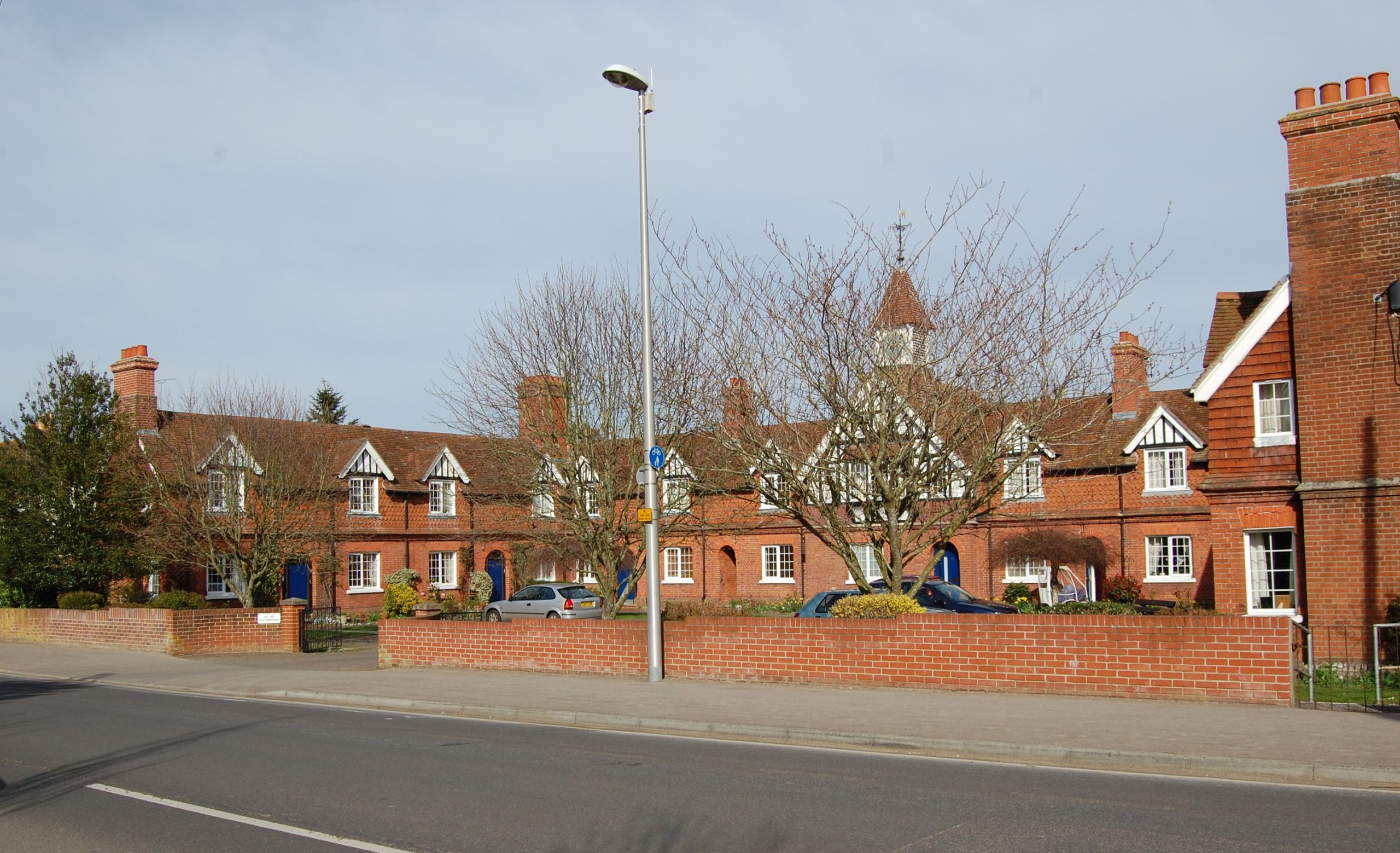
They comprise three ranges, occupying three sides of a square, with the principal front elevations facing Newtown Road. They are built of brick and tile, with a tile-hung first floor and clay tile roof.
The ground floor has round brick arches over the doorways, and there are gauged straight brick arches above the ground floor casement windows. A moulded terracotta string course, runs across all three ranges, separating the ground and first floor.
The first floor tile-hanging comprises alternate rows of simple shapes. The building features low level overhanging eaves, the line of which is below the head of first floor windows, the gables of which are decorated with timber stud work.
The central section of the east range juts forward, with a gable with (imitation) half-timbering and an oriel window (above which is a painted inscription). Above, rising from the ridge of the range, is a thin clock-tower, surmounted by a weathervane featuring points of the compass and the date ‘1879’.
Large square brick chimney stacks survive at the junctions of the ranges, with smaller stacks at the west end of the north and south ranges, and thin stacks on the east range either side of the clock tower.
Alterations and additions were made to the rear in 1982-3, removing pantries and outside toilets, and adding new bathrooms and kitchens. The principal front elevation retain their Victorian appearance.
Although many towns have almshouses, the number and variety in Newbury is unusual, as is the extent of their continuing survival. The Church and Childs’ Almshouses represent a continuation of the Church Almshouses, which existed in the 16th century, and possibly earlier. As such, they feature as part of Newbury’s social history over more than four centuries.
The present Church and Childs’ Almshouses are by architect James H. Money, a Victorian architect of local significance, responsible for a number of local buildings including Newbury Town Hall.
The Church and Childs’ Almshouses make a significant contribution to the street scene in the Newtown Road area and were identified in the Newbury Historic Character Study as being significant to Newbury.
Gallery
Location
Open the location with: Google Maps | Bing Maps | OpenStreetMap