
Built 1936-37. Architect probably Mr. A. J. Campbell Cooper (of 41 Cheap Street, Newbury), who was earlier responsible for the conversion of the adjacent 12-26 Argyle Road, also for Dr. Walter Essex Wynter.
Commissioned by Dr Walter Essex Wynter (1860-1945), of Bartholomew Manor, Argyle Road, Newbury, to provide homes for retired nurses from the Middlesex Hospital (arms of the Middlesex Hospital above the entrance.)
Known as the Nurses Homes, a name also applied to nos. 12-26 Argyle Road, with which they are sometimes confused. Both are also called Essex Wynter Almshouses.
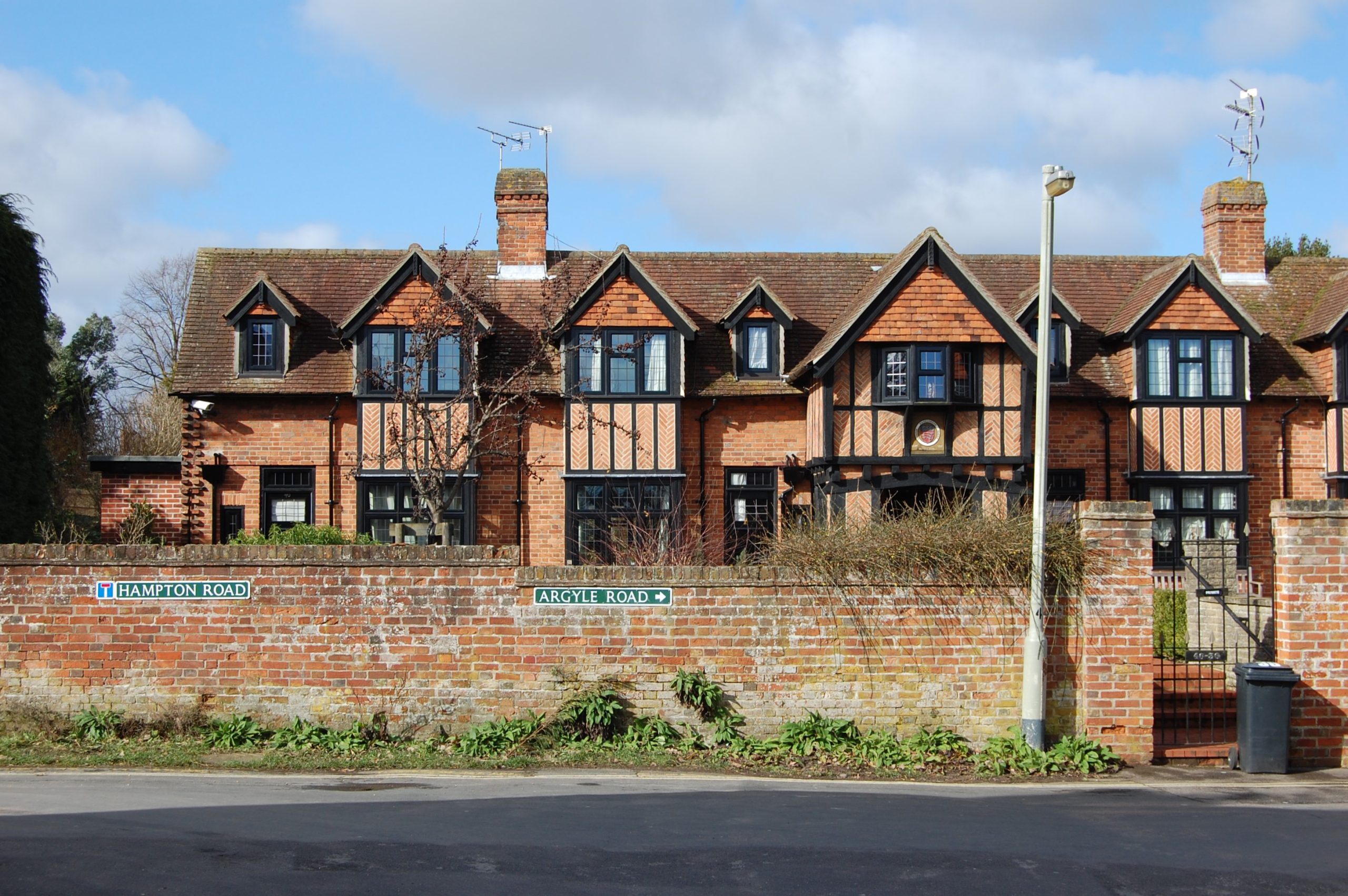
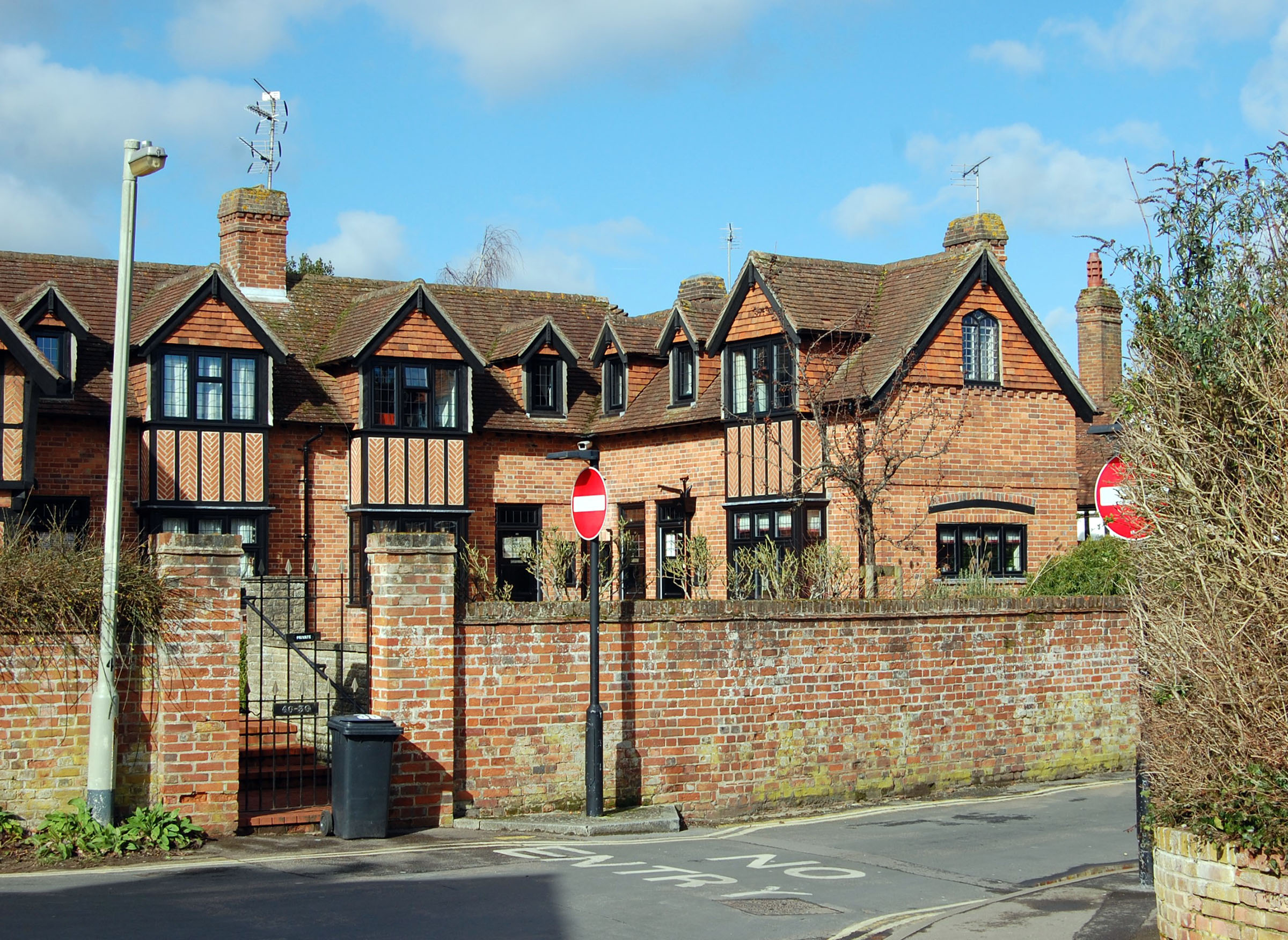
Brick structure, in a Tudor style with prominent black timbers. Arranged in an L-shape, with the main range set back and facing Argyle Road. The effect is to create a courtyard, echoing that at St Bartholomew’s Hospital, on the other side of Argyle Road, and the three-wing form of Nos. 12-26 (aka St Bartholomew’s Close or Jemmett’s almshouses).
In the centre of the main range is a projecting two-storey gabled porch, tile-hung above the Middlesex Hospital coat of arms. To each side is a small dormer, two projecting bays with tile-hung gables (effectively two-storey bay windows), and another dormer. Herringbone brickwork in porch and projecting bays. There are two ridge chimneys, between the double bays on each side.
The short foot of the ‘L’ is on the north side, and has two dormers and one projecting bay with a tile-hung gable. This section has two chimneys behind (to the N). The gables and the dormers all have wooden pendants hanging down from the point of the gable.
The tile-hung gables, with local clay tiles, are a vernacular style common in the area in the 17th century and revived in the 19th century; examples include the Camp Hopson building of 1663 (10-11 Northbrook Street); and the Weavers Cottages in West Mills of 1633. These also echo the gables of Bartholomew Close, on the corner of Argyle Road and Pound Street, without copying them.
Many of the bricks used in the front porch are about nine inches long, and appear to be genuine 16th- or 17th- century bricks (also in use at the rear); while many bricks used in the herringbone patterns on the front bays appear to be modern bricks in similar sizes. Other bricks used are clearly 20th century. Certain timbers, such as the horizontal timber on the south side of the central passage appear of some age, and reused. The local clay tiles may also have been reclaimed. Such reuse would conform with Dr Essex Wynter’s habit of using genuine period materials, salvaged elsewhere.
The brickwork on the south-east corner indicates a design ready to accommodate an additional short wing on the south side, i.e. the third side of the courtyard. Kitchens have been added at the rear.
This is worthwhile architecture in its own right but is particularly important because of the way in which it complements the other buildings in the immediate area.
Argyle Road is an area of particular importance to Newbury, as the site of the medieval St Bartholomew’s Hospital and a group of outstanding buildings in terms of heritage, many of them listed. These include not only the St Bartholomew’s Almshouses (C17), and No. 4 Bartholomew Manor and its neighbour No. 6 (C15, with C16 alterations) but also Bartholomew Close (on the corner of Pound Street), and nos. 12-26, (which were the original Raymond’s Almshouses, and were used as the Church Almshouses from the 1790s).
The area is given an element of unity by the involvement of Dr Walter Essex Wynter in the 1920s and 1930s, restoring and renovating the existing buildings, and bringing in genuinely antique materials, such as the shutters from Eton College used for nos. 12-26.
Dr Essex Wynter was also responsible for the Nurses Homes (nos. 30-40), erected in 1936-7 to complement the adjacent buildings. The effect is to provide a sense of unity to this area, in spite of the variations in building style and date.
The building is important for its association with Dr. Walter Essex Wynter (1860-1945), a prominent surgeon and a pioneer in lumbar puncture. As well as his national prominence medically, he was locally prominent for his revitalization of Argyle Road, and for his involvement in various local bodies, as a Governor of St. Bartholomew’s School, on the management committee of the nearby Newbury Hospital, and chairman of the Dispensary.
According to a West Berkshire Museum guide on local almshouses: “Dr Wynter was so keen on the Tudor look that he scoured the country to find material from demolitions to use in the new almshouses. Consequently these beautifully built buildings, although less than 100 years old have many Tudor features and are often taken to be very much older than they actually are.” (P. F. Wood & West Berkshire Museum, The Almshouses of Newbury, Heritage Guide no. 8, West Berkshire Museum, Newbury 2006.no. 23). This is supported by many bricks and some timbers in nos. 30-40.
R. Neville Hadcock, in the Borough of Newbury official guide (1949 and later editions), described them as “a delightful modern building with a picturesque porch,” a description he repeated in his 1979 Story of Newbury. This description is echoed in the 1973 Newbury Buildings Past and Present, which described them as “a pleasing modern building in traditional style with a picturesque porch.
The Nurses Homes are recognized in the Oxford Archaeology Newbury Historic Character Study, 2006, where they are described as significant to Newbury but unlisted. They are also mentioned in the 2010 Pevsner for Berkshire (p. 401).
Gallery
Location
Open the location with: Google Maps | Bing Maps | OpenStreetMap