
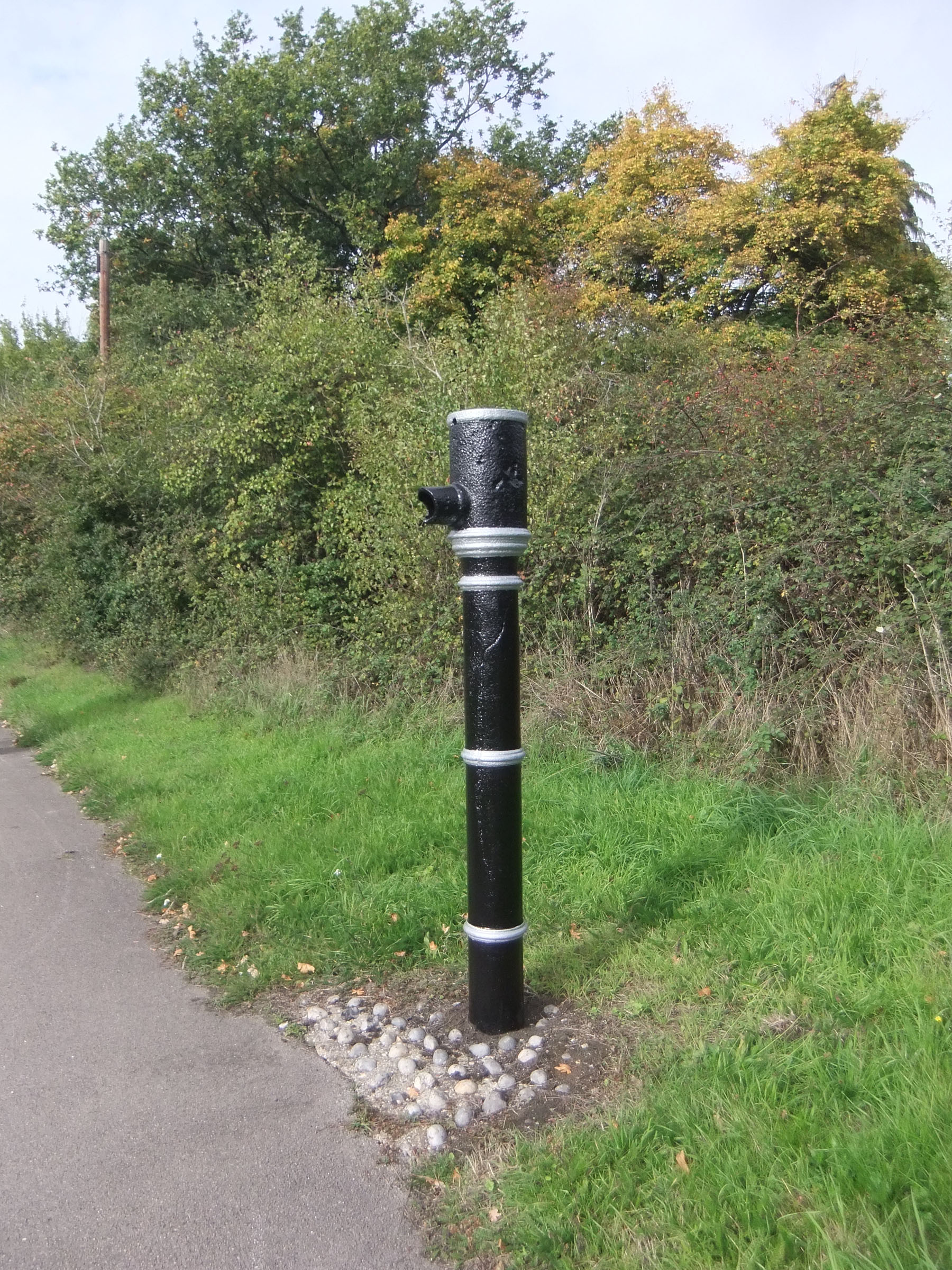
Cast iron water pump located on the Station road roundabout by Siege Cross Farm to the north side of the A4.
This water pump is one of four C18/C19 cast iron water pumps located along the A4 in Thatcham. Each water pump has been listed separately. Their locations are as follows:
- 16/00012/LOCAL Bath Road, Thatcham (south side of A4, outside Francis Baily School)
- 16/00013/LOCAL London Road, Thatcham (north side of A4, on the Station Road roundabout by Siege Cross Farm)
- 16/00014/LOCAL Benham Hill, Thatcham (south side of Benham Hill, east of the junction with Pound Lane)
- 16/00015/LOCAL London Road/Benham Hill, Thatcham (south side of A4 at junction of with Lower Way
The pumps would have been erected after the road became part of the coach route from London to Bath. There is no evidence that these were pumps to water horses or provide water for the villagers, and the most likely explanation is that the pumps served to bring water to the road to lay the dust after the coaches went past. The provision of such pumps is addressed by Daphne Phillips in her book The Great Road to Bath. The HER record for Thatcham identifies that a further fifth pump existed in the area of the Northfield Road/A4 junction but was probably lost in the 1920’s. There are HER records of other similar pumps, some still extant, along the A4 Bath Road in West Berkshire.
The pumps are similar in design to others found on coaching roads and probably date from the late 1700’s or early 1800’s.
The Bath Road water pump comprises a straight undecorated column in several sections. It has a crack in the metal down the length of the pump, the majority of the spout has been lost to corrosion and it no longer has its original pump handle.
Notwithstanding the current condition of the pump, when assessed as a group with the other three remaining pumps along the A4 in Thatcham, it forms part of an important historical record of the coaching period, along what was at the time on of the most important coaching routes in the country (the first ever mail coach went from Newbury in the 1700’s, providing a pattern for later routes).
HER Reference MWB18084
Gallery
Location
Open the location with: Google Maps | Bing Maps | OpenStreetMap